
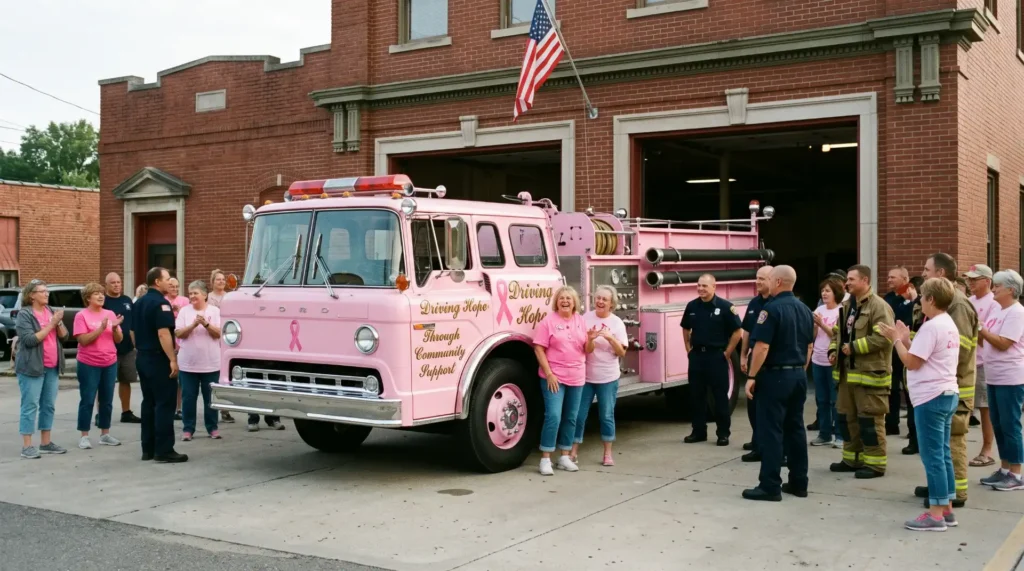
A fire truck has a special place in American communities. For generations, these powerful vehicles have represented courage, public service, teamwork, and the promise that help will arrive when people need it most. Their distinctive appearance, familiar sirens, and unmistakable presence make them some of the most recognizable vehicles on American roads. However, when a fire department replaces an aging engine with newer equipment, the older vehicle does not necessarily have to disappear from public life.
Across the United States, communities have opportunities to give retired fire trucks a meaningful second purpose. Instead of allowing a historically important vehicle to become unused equipment, local organizations, firefighters, volunteers, and cancer awareness advocates can explore transforming it into a pink awareness vehicle. With thoughtful planning, appropriate restoration, and a clear community mission, an old fire engine can become a rolling symbol of hope, solidarity, and support for people affected by cancer.
A retired fire truck converted into a pink awareness vehicle can participate in parades, community celebrations, charity events, educational programs, survivor recognition ceremonies, and fundraising activities. It can also preserve a piece of local firefighting history while introducing a new generation to the importance of community involvement.
The transformation, however, involves much more than applying pink paint and adding a ribbon to an old emergency vehicle. Communities must consider the truck’s mechanical condition, ownership, restoration expenses, transportation requirements, safety, insurance, fundraising arrangements, and long-term maintenance. They must also develop a meaningful outreach mission that gives the vehicle a purpose beyond attracting attention.
Understanding these responsibilities can help communities turn an aging fire engine into something genuinely valuable: a vehicle that continues serving people long after its emergency response career has ended.
Why Retired Fire Trucks Deserve a Second Life
Fire departments periodically replace older apparatus because emergency response requirements, equipment technology, maintenance needs, and operational expectations change. A fire engine that once served as the primary vehicle for a busy station may eventually become too old, expensive, or unsuitable for frontline operations.
Retirement does not necessarily mean that every component of the vehicle has reached the end of its useful life. Some older fire engines retain attractive exterior features, recognizable designs, substantial historical significance, and mechanical components that may still be suitable for a carefully planned non-emergency purpose.
A community organization interested in a pink fire truck project can begin by understanding the difference between an emergency vehicle and a retired vehicle used for public outreach.
An active fire engine must meet demanding operational requirements. It carries firefighting equipment, water, hoses, tools, and personnel while responding to emergencies. A retired vehicle used for awareness activities has a different purpose. It may be displayed at public events, transported to community celebrations, or used as a stationary educational attraction.
This distinction matters because a vehicle that is no longer suitable for emergency response should not automatically be assumed safe for regular road use. Before any conversion begins, qualified professionals should evaluate the truck and determine what work is necessary for its intended new role.
Preserving Local Firefighting History
Many retired fire trucks have stories that are worth preserving. An engine may have served the same city for several decades, responded to major emergencies, participated in historic community celebrations, or been associated with generations of firefighters.
Residents who remember seeing the truck outside their neighborhood fire station may feel a strong emotional connection to it. Former firefighters may recognize its original equipment, station markings, or unique design features.
Rather than removing every sign of its history, a pink awareness conversion can incorporate selected historical details into the finished vehicle.
For example, a community could preserve the original manufacturer emblem, restore a historical station number, or display a small plaque identifying the engine’s former department and years of service. The new pink exterior would represent its current mission, while selected original features would acknowledge its earlier contribution.
This combination creates a meaningful connection between the vehicle’s past and its future.
 Giving an Old Vehicle a New Community Purpose
A retired fire engine can also provide an opportunity for organizations that want to raise awareness without purchasing a brand-new specialty vehicle.
Although restoration and conversion can be expensive, an existing vehicle may provide a useful starting point if its condition and ownership arrangements are favorable. The community can concentrate its resources on necessary repairs, exterior restoration, accessibility improvements, and awareness-related modifications.
A pink awareness fire truck can then become a recognizable centerpiece for activities throughout the year.
It might visit local schools, attend community festivals, participate in charity walks, appear at survivor appreciation events, or support partnerships with healthcare organizations.
Its purpose should be clearly established before restoration begins. A vehicle with a defined mission is more likely to attract volunteers, sponsors, donations, and long-term community support.
Finding the Right Retired Fire Engine for Conversion
The first major challenge is finding a suitable vehicle.
Not every retired fire engine is an appropriate candidate for a pink awareness conversion. Some may have extensive mechanical problems, structural corrosion, damaged frames, missing components, or maintenance histories that make restoration financially impractical.
Communities should avoid selecting a truck based exclusively on its appearance or historical importance. A vehicle that looks attractive in photographs may require extensive mechanical work before it can safely travel to public events.
Contacting Local Fire Departments and Municipalities
Local fire departments are often the most logical starting point for a retired fire truck project.
Municipal governments periodically replace emergency vehicles, and older apparatus may be sold through public auctions, transferred to other agencies, or disposed of according to local government procedures.
A community organization can contact the fire chief, municipal fleet manager, purchasing department, or city administration to ask whether retired fire apparatus may become available.
The organization should explain its proposed project, intended use, funding arrangements, and plans for maintaining the vehicle.
A clear proposal is important because municipal vehicles are public assets. Fire departments generally cannot simply give away equipment without considering applicable purchasing rules, property-disposal policies, and government approval requirements.
Some municipalities may prefer to sell retired equipment through an auction. Others may consider donations or transfers to eligible nonprofit organizations when legally permitted.
Community organizers should investigate these possibilities rather than assuming that an old fire engine can be obtained without cost.
Exploring Fire Apparatus Auctions
Public auctions can provide another opportunity to acquire a retired fire truck.
Municipalities, government agencies, and other organizations sometimes dispose of vehicles through established auction platforms. These sales may include pumpers, tankers, ladder trucks, rescue vehicles, and older apparatus that have been removed from emergency service.
However, auction purchases require careful evaluation.
A low purchase price does not necessarily represent a good deal. The truck may have engine problems, transmission damage, deteriorated tires, electrical faults, corrosion, or missing equipment. It may also require specialized transportation because it cannot legally or safely be driven away.
Potential buyers should request available maintenance records, vehicle identification information, photographs, inspection reports, and details about known defects.
Whenever possible, a qualified emergency vehicle technician or heavy-duty vehicle mechanic should inspect the apparatus before purchase.
Choosing a Vehicle That Matches the Project
The size and type of fire engine should reflect the organization’s long-term plans.
A smaller pumper may be easier to maintain and transport than a large ladder truck. A vintage engine may attract attention at historical celebrations, while a more modern apparatus could offer additional convenience for public outreach activities.
The organization should consider storage space, parking availability, operating costs, event access, and the availability of replacement parts.
It should also consider whether the truck will travel regularly or primarily remain stationary.
A vehicle intended for occasional parade appearances has different requirements from one expected to travel across several states throughout the year.
The best choice is not necessarily the largest or most impressive fire engine. It is the vehicle that the organization can responsibly maintain and operate within its available resources.
Planning the Conversion From Emergency Apparatus to Pink Awareness Vehicle
Once a suitable fire truck has been identified, the organization must develop a conversion plan.
This stage is where a retired emergency vehicle begins its transition into a community outreach asset.
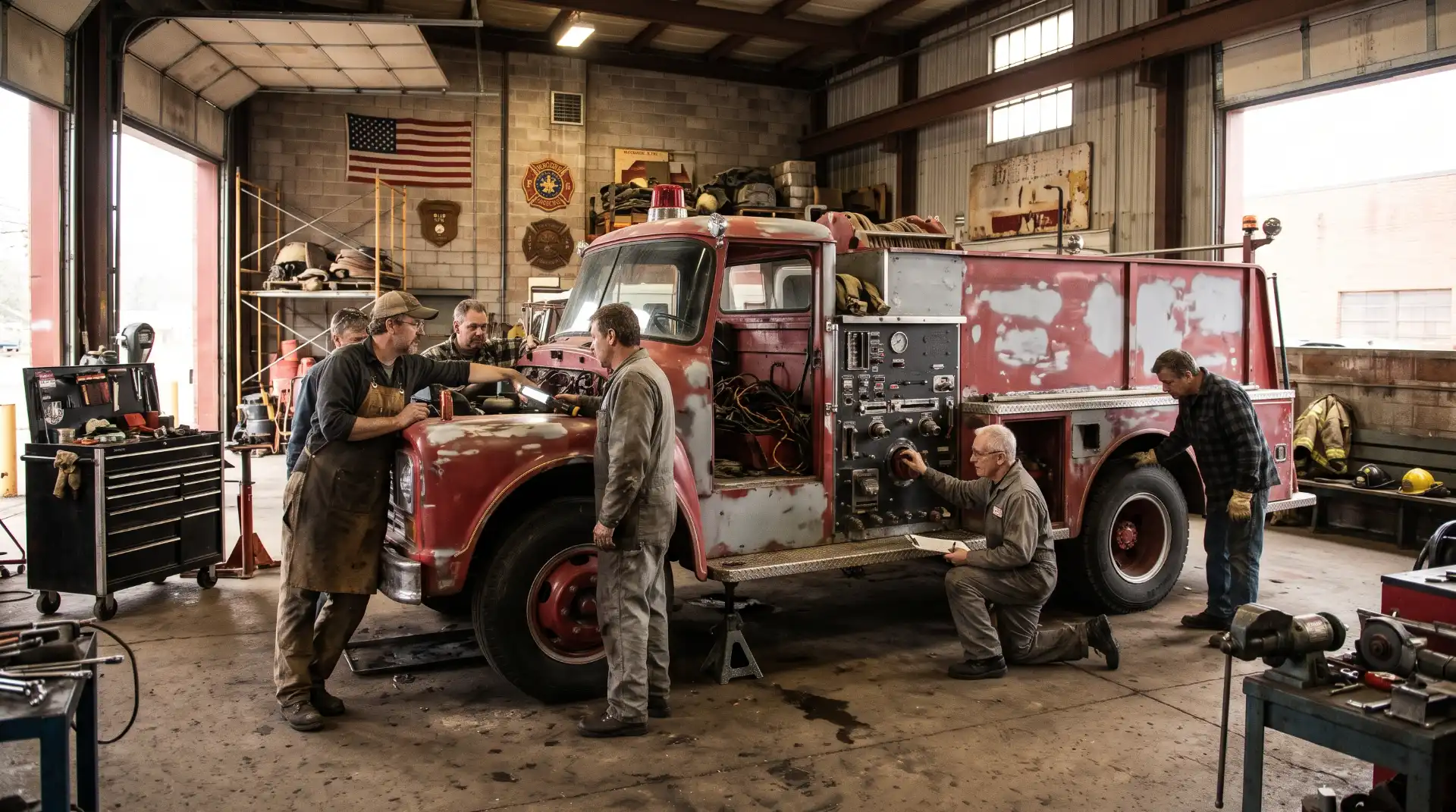
The work should be organized into several stages, including inspection, mechanical evaluation, equipment removal, body preparation, painting, branding, and final safety checks.
Start With a Professional Mechanical Inspection
Before spending money on cosmetic improvements, organizers should determine the vehicle’s mechanical condition.
An inspection should cover the engine, transmission, brakes, steering, suspension, tires, electrical systems, frame, fuel system, cooling system, and other components relevant to the intended use.
Older fire trucks may have specialized mechanical systems that require technicians familiar with emergency apparatus.
The inspection should also identify potential problems involving the vehicle’s weight, dimensions, and structural condition.
If the organization intends to operate the vehicle on public roads, it must establish that the truck can be brought into compliance with applicable state and federal requirements for its new configuration.
The National Fire Protection Association provides standards addressing emergency vehicle inspection, maintenance, refurbishment, testing, and retirement. Its NFPA 1910 standard is particularly relevant when understanding the professional maintenance and safety considerations associated with in-service emergency vehicles.
The standard should not be interpreted as automatic approval for converting a retired engine into a public awareness vehicle. Instead, it provides an important reference point for understanding why professional inspections and appropriate maintenance practices matter.
Determine Which Original Components Should Remain
Retired fire engines often contain specialized equipment that may no longer be necessary for their new mission.
Depending on the vehicle, this can include firefighting pumps, hose beds, water tanks, ladders, emergency lighting, sirens, cabinets, and other operational equipment.
The organization should work with qualified professionals to determine which components should remain, which can be safely removed, and which should be preserved for historical or educational purposes.
Some equipment may be useful for demonstrations or historical displays. Other components may add unnecessary weight, increase maintenance costs, or create safety concerns.
Any removal or modification should be documented.
For example, an organization might retain a restored hose reel or an original equipment panel as part of the vehicle’s historical display while removing damaged or unnecessary equipment.
The goal should be to create a practical and visually appealing awareness vehicle without compromising safety or creating avoidable mechanical problems.
Preparing the Exterior for Its New Identity
The exterior transformation is often the most recognizable part of the project.
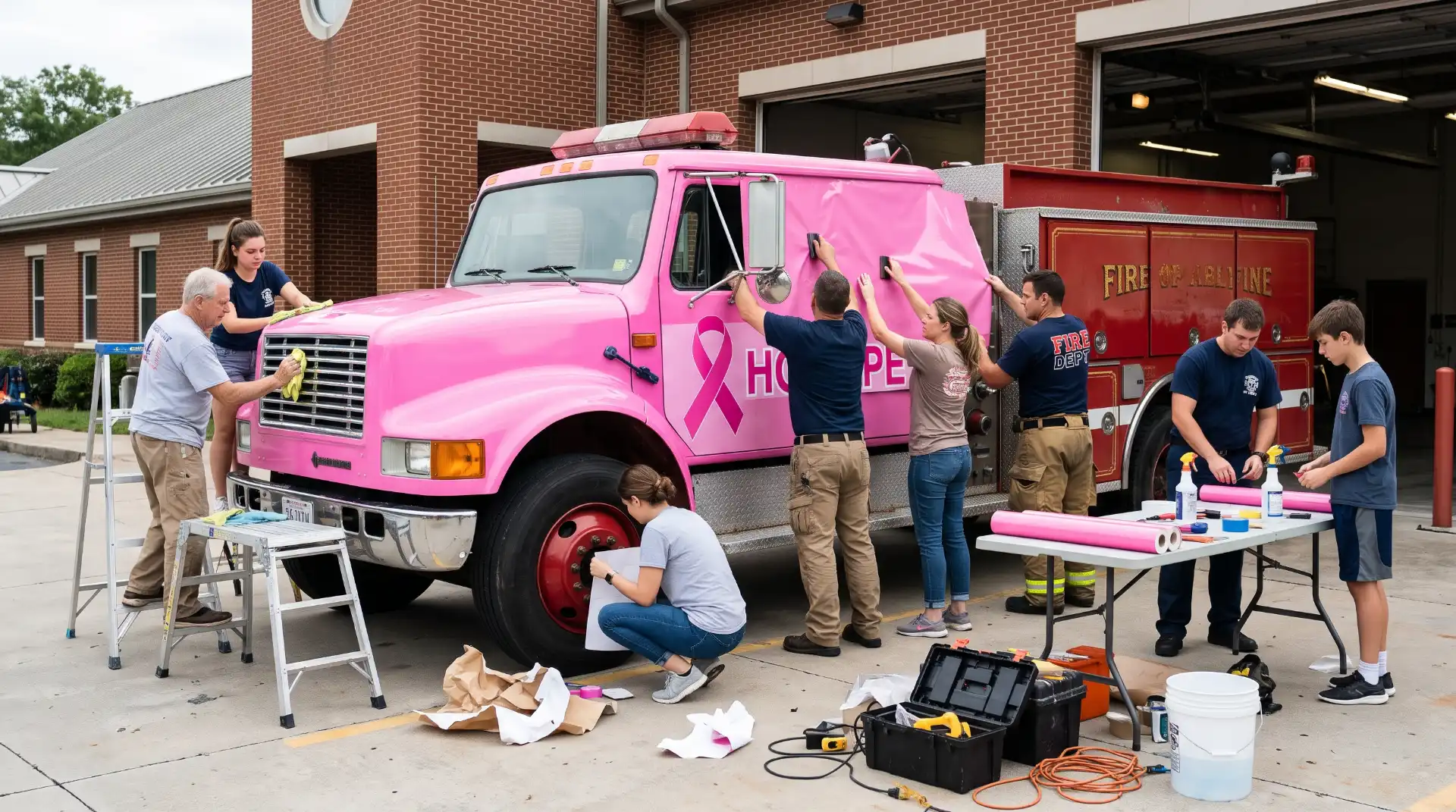
A traditional red fire engine can become a pink awareness vehicle through professional refinishing, custom paintwork, or a suitable vehicle wrap.
Before painting begins, the body should be inspected for rust, dents, corrosion, damaged panels, and deteriorated finishes.
Old decals, outdated department markings, and damaged lettering may need to be removed. The surface should then be properly prepared so that the new finish looks professional and remains durable.
Communities should choose a pink color scheme that reflects the project’s identity and mission.
Some organizations prefer bright pink because it is highly visible during parades and public celebrations. Others choose a softer shade that creates a more understated appearance.
The color itself is less important than maintaining a consistent visual identity that people can recognize.
 Paint Versus Vinyl Wrap: Which Is Better?
Two common options for transforming a fire truck’s exterior are repainting and applying a vinyl wrap.
Professional repainting can create a durable finish and may be appropriate when the vehicle requires extensive body restoration. However, painting a large fire engine can be expensive because of its size, complex surfaces, and preparation requirements.
A vinyl wrap may provide more flexibility. It allows organizations to incorporate custom graphics, awareness messages, sponsor acknowledgments, and historical details without permanently changing every exterior surface.
Wraps may also make future design updates easier.
However, the choice depends on the truck’s condition, the quality of the materials, exposure to weather, maintenance requirements, and the organization’s budget.
A professional vehicle graphics company should evaluate the surface and recommend a suitable solution.
Regardless of the approach, the finished appearance should be consistent and readable. Excessive graphics, crowded sponsor logos, or conflicting messages can make the vehicle less effective as an awareness platform.
Designing a Pink Fire Truck That Tells a Story
A successful pink awareness vehicle should communicate more than its color.
People should be able to understand its purpose when they see it at a parade, community festival, or public gathering.
The design should communicate compassion, remembrance, solidarity, and support while maintaining the distinctive appearance of a traditional American fire engine.
Incorporating Awareness Ribbons and Community Messages
Pink ribbons are widely recognized as symbols associated with breast cancer awareness.
They can be incorporated into the vehicle’s design through exterior graphics, side-panel artwork, decorative accents, or a prominent awareness emblem.
However, the design should also include a clear message explaining the vehicle’s purpose.
Possible messages include:
- Driving Hope Through Community Support
- Honoring Survivors, Remembering Loved Ones
- Together for Awareness and Hope
- A Community United Against Cancer
The wording should be respectful, easy to read, and appropriate for different audiences.
Communities should avoid making unsupported medical claims or suggesting that the vehicle itself provides healthcare services.
Its role is to promote awareness, encourage community participation, and connect people with legitimate resources.
Honoring Survivors and Families
One of the most meaningful features of a pink fire truck can be its connection to real people.
Communities may choose to dedicate the vehicle to a survivor, a firefighter who experienced cancer, a family member, or a local resident whose story inspired the project.
A small dedication plaque can explain the person’s connection to the community and the reason the truck carries its message.
Some awareness vehicle programs also allow people to leave signatures or personal messages on designated surfaces.
This creates an opportunity for survivors, families, firefighters, and supporters to participate directly in the vehicle’s story.
Before displaying someone’s name, photograph, or personal experience, organizers should obtain appropriate permission.
Cancer experiences are personal, and individuals should never feel pressured to share medical information publicly.
Keeping the Original Fire Truck Character
A pink conversion does not need to erase the vehicle’s firefighting identity.
Original chrome details, restored mirrors, historical lettering, traditional wheels, and selected equipment can help preserve the engine’s recognizable appearance.
This balance is important because the vehicle’s connection to the fire service is part of what makes it distinctive.
A well-designed pink fire truck should look like a respected former member of the fire department that has taken on a new mission.
It should not resemble an unrelated promotional vehicle with a fire truck body.
Creating a Realistic Budget for a Pink Fire Truck Project
One of the biggest obstacles to converting retired fire engines is cost.
Although the original vehicle may be inexpensive or donated, restoration can require substantial financial resources.
Communities should prepare a realistic budget before accepting a vehicle or beginning work.
Understanding the Main Restoration Expenses
The purchase or acquisition of the fire truck is only the beginning.
A conversion budget may include:
Vehicle acquisition: Purchase costs, auction fees, title transfers, inspections, and transportation.
Mechanical repairs: Engine maintenance, brake repairs, tires, electrical work, suspension components, and other necessary improvements.
Body restoration: Rust removal, panel repairs, surface preparation, paintwork, and replacement of damaged exterior parts.
Custom graphics: Vinyl wraps, awareness ribbons, lettering, sponsor displays, and dedication plaques.
Safety modifications: Appropriate lighting, mirrors, warning devices, accessibility improvements, and other modifications required for the intended operation.
Storage: Secure parking, covered storage, and protection from weather.
Insurance and registration: Applicable vehicle registration, inspections, insurance premiums, and administrative expenses.
Ongoing maintenance: Fuel, oil changes, repairs, cleaning, tires, and periodic professional inspections.
Each category should have a separate estimated cost.
This makes it easier for organizers to understand which expenses are essential and which improvements can be postponed.
Why a Contingency Fund Matters
Older vehicles can develop unexpected problems.
A truck that passes an initial inspection may still require additional repairs once restoration begins. Removing old equipment can expose corrosion or reveal damaged electrical connections.
For this reason, the project should include a contingency reserve.
The amount will depend on the truck’s age, condition, complexity, and inspection findings.
Organizers should avoid spending the entire budget on paint and graphics while leaving insufficient money for mechanical repairs and insurance.
A beautiful vehicle that cannot safely reach its scheduled events is not a successful community project.
Comparing Restoration Costs With Other Options
Sometimes the best financial decision is not to restore a particular truck.
If a vehicle requires extensive mechanical work, a community might be better served by finding another retired engine in better condition.
Another option is to acquire a vehicle that has already been converted for public outreach.
A smaller retired fire vehicle may also provide a more affordable alternative.
The organization should compare the total cost of acquisition, restoration, maintenance, storage, and operation over several years.
This approach helps prevent a project from becoming financially unsustainable.
How Communities Can Fund a Retired Fire Truck Conversion
A pink fire truck project can attract support from individuals, businesses, civic organizations, and local government representatives.
The vehicle itself can become a fundraising centerpiece because potential supporters can see exactly what their contributions are helping to create.
However, successful fundraising requires transparency and a clear explanation of how the money will be used.
Local Business Sponsorships
Local businesses may be interested in supporting a project that combines public service, community involvement, and cancer awareness.
Automotive repair shops, dealerships, body shops, transportation companies, restaurants, hardware stores, and printing businesses may offer financial contributions, materials, or professional services.
For example, a local collision repair business could sponsor body preparation, while a vehicle graphics company might provide discounted lettering.
A tire dealership could help with replacement tires, and a commercial mechanic could donate inspection hours.
These arrangements can reduce the financial burden without requiring every supporter to contribute cash.
Sponsor recognition should be handled carefully. Businesses can receive appropriate acknowledgment through event banners, websites, and designated vehicle graphics without allowing commercial advertising to overwhelm the awareness mission.
Community Donation Campaigns
Crowdfunding and local donation campaigns can help finance the conversion.
An organization might publish photographs of the retired engine, explain its history, describe the proposed transformation, and establish a fundraising target.
Supporters can then follow the restoration process and see how contributions are being used.
Progress updates are especially important.
Instead of simply announcing that money is needed, organizers can show completed milestones, such as the initial inspection, mechanical repairs, exterior preparation, and final pink finish.
This helps donors feel connected to the project.
The organization should also explain whether donations are tax-deductible. That depends on the legal status of the receiving organization and applicable tax rules. Contributions to an individual or an ordinary commercial entity do not automatically qualify as charitable donations.
Grants and Community Foundation Support
Local foundations, civic organizations, and community grant programs may provide another funding opportunity.
Some programs support historic preservation, public education, volunteer activities, cancer awareness, or community development.
A retired fire engine conversion may fit certain funding priorities if the proposal clearly demonstrates public benefit.
The application should explain:
- The history of the vehicle.
- Why the community wants to preserve it.
- How the pink awareness mission will operate.
- Which organizations will participate.
- How the project will reach residents.
- How expenses will be monitored.
- How the vehicle will be maintained after completion.
A grant proposal should emphasize measurable outcomes rather than relying entirely on emotional language.
For example, organizers can describe the number of community appearances planned, the partnerships they intend to establish, and the educational resources they will distribute.
Firefighter Associations and Civic Organizations
Firefighter associations, veterans’ organizations, service clubs, and local civic groups may also support the project.
These organizations often have established community relationships and volunteers who understand the importance of public service.
Their participation can help with fundraising, event coordination, historical research, and vehicle preservation.
A project that combines firefighters, cancer survivors, local businesses, and civic organizations may attract broader support than one managed by a small group without community partnerships.
Building Partnerships With Fire Departments and Cancer Organizations
A pink awareness vehicle becomes much more useful when it is connected to established community organizations.
Fire departments can provide historical knowledge, volunteers, and public safety guidance. Cancer organizations can help ensure that educational messages are accurate and that fundraising activities support legitimate programs.
Healthcare providers may also contribute educational materials and direct residents toward appropriate medical resources.
Working With Local Fire Departments
Even after the truck has been retired, the former department may remain an important partner.
Former firefighters can share the vehicle’s history, help identify original equipment, and participate in dedication ceremonies.
The department may also help introduce the project to municipal leaders and other public safety organizations.
However, the responsibilities of the retired vehicle’s owner and the active fire department should remain clearly separated.
The pink awareness truck should not be presented as an active emergency response unit unless it has been formally approved and equipped for that role.
Its new mission should be clearly identified as community outreach.
Partnering With Established Pink Fire Truck Organizations
Communities do not necessarily have to develop every aspect of a pink fire truck program independently.
Existing organizations can provide examples of how awareness vehicles operate and how community participation can be organized.
For example, Pink Heals describes a community-based movement involving pink fire trucks, local fundraising, survivor recognition, and volunteers who travel to different communities.
Its approach illustrates how a pink vehicle can become more than a temporary awareness display.
A local organization considering a similar project can study established programs to understand volunteer responsibilities, community engagement, and the importance of connecting vehicle appearances with meaningful support.
Any organization considering formal affiliation should contact the relevant program directly and obtain permission before using its name, logo, or branding.
Connecting With Hospitals and Cancer Support Groups
Local hospitals, cancer centers, and survivor support organizations can help make the vehicle’s outreach mission more meaningful.
A pink fire truck could appear at an approved hospital community event, survivor celebration, or educational gathering.
Healthcare partners may provide brochures about screening resources, patient navigation, and available support services.
They can also help volunteers understand which health messages are appropriate to share.
The vehicle should never be treated as a substitute for professional medical advice.
Its purpose is to open conversations, encourage people to seek reliable information, and create a welcoming environment for community support.
Turning the Pink Fire Truck Into a Mobile Community Outreach Program
After restoration, the next challenge is ensuring that the vehicle remains active and useful.
A successful pink awareness fire truck should have a calendar of activities, trained volunteers, and a clear outreach strategy.
Without a plan, even a beautifully restored vehicle may spend most of the year parked in storage.
Participating in Parades and Community Celebrations
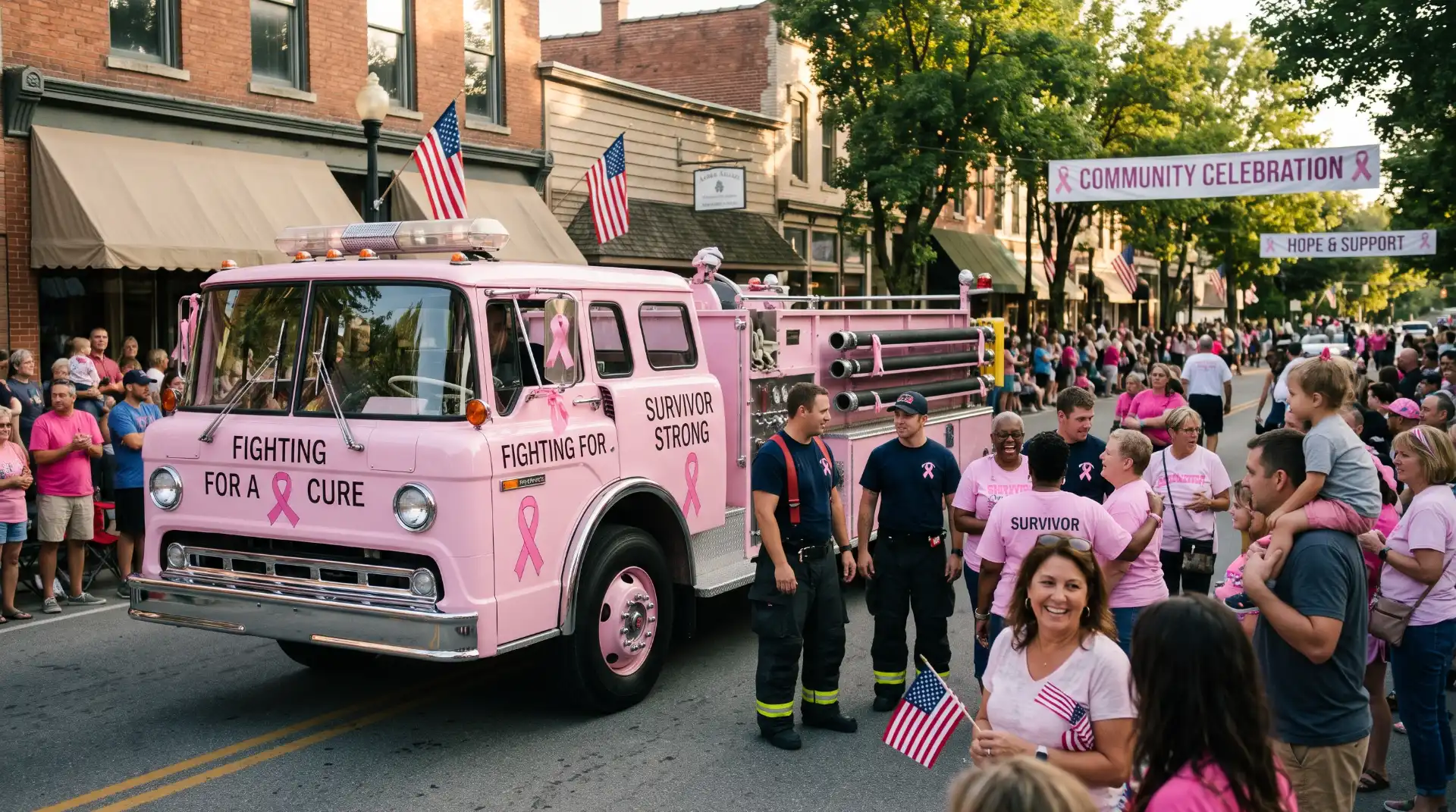
Local parades provide an opportunity to introduce the restored vehicle to a large audience.
The truck can participate in holiday celebrations, municipal anniversaries, civic events, and community festivals.
Its appearance can attract attention while introducing residents to the organization’s mission.
Organizers should coordinate with parade officials well in advance.
They must confirm vehicle dimensions, route restrictions, operating conditions, insurance requirements, and any rules governing retired emergency apparatus.
The vehicle should also be inspected before every major appearance.
A parade is not the place to discover that the brakes, tires, or steering system require attention.
Visiting Schools and Youth Organizations
A retired pink fire truck can provide an engaging educational opportunity for young people.
Schools may invite the vehicle to participate in career days, public safety events, or community service activities.
Students can learn about the history of firefighting, the process of restoring historic vehicles, and how public service organizations support community causes.
The vehicle can also introduce young people to volunteerism and fundraising.
For example, a school might organize a community awareness project in which students create messages of encouragement for survivors or learn about the importance of supporting families affected by serious illness.
All activities should be age-appropriate and coordinated with school administrators.
Supporting Survivor Recognition Events
One of the most meaningful uses of a pink fire truck is survivor recognition.
A restored vehicle can serve as a centerpiece for events honoring people who have experienced cancer and families who have supported loved ones through treatment.
These events should be designed around the participants rather than the vehicle.
Survivors should have the opportunity to decide whether they want to be photographed, interviewed, recognized publicly, or included in promotional materials.
Some may appreciate public recognition, while others may prefer a private or low-profile experience.
Respecting these preferences helps ensure that the project remains compassionate rather than becoming a publicity exercise.
Organizing Awareness Tours
A community may eventually decide to take its pink fire truck beyond its original town.
Regional tours can introduce the vehicle to neighboring cities, small towns, schools, and local organizations.
Each visit should have a defined purpose.
Rather than simply driving through communities, organizers can coordinate with local partners to arrange meaningful activities.
These might include survivor recognition, volunteer recruitment, fundraising events, public education, or historical vehicle displays.
Tour planning must account for transportation costs, lodging when necessary, maintenance, driver qualifications, and insurance.
A regional awareness tour should only proceed when the organization has enough financial and operational support to complete it responsibly.
Safety, Legal Responsibilities, and Vehicle Compliance
The emotional value of a pink awareness fire truck does not eliminate the legal responsibilities associated with operating a large retired vehicle.
This is one of the most important parts of any conversion project.
A vehicle that was previously registered as emergency apparatus may require changes to its title, registration, insurance classification, equipment, or permitted use.
Requirements vary by state and sometimes by county or municipality.
Understanding the Difference Between Display and Road Use
Communities should determine whether the truck will be used exclusively as a stationary display or whether it will travel on public roads.
A stationary display may still require safe handling, secure parking, crowd-control arrangements, and appropriate transportation to its destination.
A vehicle intended for road use requires a much more extensive evaluation.
Its brakes, tires, steering, lights, mirrors, structural components, and other systems must be appropriate for its operating conditions.
Organizers should contact their state motor vehicle agency and relevant local authorities to determine applicable registration, inspection, equipment, and licensing requirements.
Removing Emergency Equipment Responsibly
A retired fire truck may contain emergency warning lights, sirens, communications equipment, and other components associated with emergency operations.
Communities should not assume that these items can remain operational simply because the vehicle has been repurposed.
State laws and local regulations may restrict the use of emergency warning devices and sirens.
Before operating the vehicle, organizers should determine which equipment must be removed, disabled, modified, or retained for a legally permitted purpose.
The truck should not imitate an active emergency response vehicle or create confusion among motorists.
Clear identification as a retired community awareness vehicle can help prevent misunderstandings.
Insurance and Liability Protection
Insurance is another essential consideration.
The organization should speak with an insurance professional who understands commercial vehicles, nonprofit operations, public events, and large specialty vehicles.
Coverage needs may include vehicle liability, physical damage, event-related liability, and protection for volunteers or employees where applicable.
The organization should also review the responsibilities of event organizers and property owners.
For example, a festival may require proof of insurance before allowing the truck onto its grounds.
Written agreements can help clarify who is responsible for the vehicle, who may operate it, and what happens if damage occurs.
Driver Qualifications and Volunteer Training
Not every volunteer should automatically be allowed to drive a retired fire engine.
Large apparatus can be difficult to maneuver, particularly in crowded parking lots, narrow streets, and event areas.
The organization should establish written driver requirements based on the vehicle’s size, weight, registration classification, and applicable state and federal regulations.
Depending on the vehicle and its use, a commercial driver’s license or other qualifications may be required.
Drivers should receive appropriate training and demonstrate familiarity with the truck’s dimensions, braking characteristics, turning radius, and visibility limitations.
A responsible program should also maintain driver authorization records and establish procedures for pre-trip inspections.
Creating a Long-Term Maintenance and Preservation Plan
Restoration is only the beginning of a retired fire truck’s second life.
Older vehicles require ongoing attention, and maintenance expenses can become a significant financial responsibility.
A community that wants its pink awareness truck to remain active for many years should create a written maintenance plan before the vehicle enters regular public service.
Scheduling Routine Inspections
The organization should establish a regular inspection schedule based on the vehicle manufacturer’s recommendations, applicable regulations, and professional advice.
Inspections may cover tires, brakes, steering, lights, fluids, battery condition, electrical systems, and structural components.
Any concerns should be documented and addressed before the vehicle returns to public roads.
Maintenance records should include dates, work performed, replacement parts, inspections, and repair costs.
This documentation helps the organization understand the vehicle’s condition and plan future expenses.
Protecting the Truck From Weather
A restored fire engine can lose its appearance quickly if it is exposed to harsh weather without proper protection.
Sunlight can damage paint and vinyl graphics. Moisture can contribute to corrosion, while freezing temperatures may create problems with fluids and mechanical components.
Whenever possible, the vehicle should be stored in a secure covered facility.
Regular cleaning and appropriate surface protection can help preserve its exterior.
If the truck has original historical features, those components should receive special attention.
Preservation should be considered part of the project’s mission rather than an optional expense.
Keeping a Reserve Maintenance Fund
Organizations should set aside money for future repairs.
This reserve can help cover unexpected tire replacements, battery problems, mechanical failures, or damage caused during transportation.
A separate maintenance account also makes financial reporting easier.
Donors and sponsors should understand that maintaining the vehicle is part of supporting the awareness program.
A project that raises money for restoration but ignores future maintenance may struggle to remain operational.
 Measuring the Impact of a Pink Awareness Fire Truck
The success of a pink fire truck project should not be measured exclusively by the number of people who take photographs with it.
A vehicle can attract considerable attention without producing meaningful community benefits.
Organizers should establish clear goals and measure whether the truck is helping achieve them.
Tracking Community Engagement
The organization can record how many public events the truck attends, how many people visit its display, and how many volunteers participate.
It can also monitor website visits, newsletter registrations, social media engagement, and requests for future appearances.
These figures help demonstrate whether the vehicle is reaching new audiences.
However, attendance alone does not reveal whether the project is accomplishing its mission.
Measuring Fundraising Results
If the pink fire truck supports charitable fundraising, organizers should maintain transparent records of donations and expenses.
Reports can explain how much money was raised, which organization received the proceeds, and how the funds were used.
For example, a community might establish an agreement with a recognized cancer support organization to direct donations toward transportation assistance or patient support programs.
Clear reporting helps build donor confidence and encourages long-term sponsorship.
Collecting Community Stories
Personal stories can demonstrate the emotional value of the project.
A survivor might describe how seeing the truck at a community celebration made them feel recognized and supported.
A former firefighter might explain why preserving the old engine was important to the department.
A volunteer might describe how participating in the restoration introduced them to community service.
With permission, these stories can be shared through newsletters, websites, and social media.
They help demonstrate that the vehicle represents real relationships rather than simply a colorful promotional campaign.
Common Mistakes Communities Should Avoid
A retired fire engine conversion can be an exciting undertaking, but several mistakes can undermine the project.
One common problem is purchasing a vehicle before conducting a professional inspection. Organizers may become emotionally attached to an attractive vintage engine without understanding the cost of repairing it.
Another mistake is concentrating too heavily on appearance. A bright pink finish may attract attention, but the vehicle still needs appropriate mechanical condition, insurance, storage, and maintenance.
Some organizations also underestimate the importance of defining their mission. Without clear goals, the truck may become an expensive attraction that participates in occasional events without creating lasting community value.
Poor financial planning is another risk. A project should not depend entirely on one fundraiser or one business sponsor. It needs a realistic operating budget and a strategy for replacing financial support when individual contributors withdraw.
Finally, organizers should avoid using personal stories, photographs, organizational names, or copyrighted branding without permission.
A successful awareness vehicle depends on trust. Respectful communication, financial transparency, and responsible operations should remain central to the project.
A Practical Step-by-Step Plan for Transforming an Old Fire Truck
Communities interested in creating a pink awareness vehicle can benefit from following a structured process.
Step 1: Establish the Project’s Mission
Begin by deciding why the community wants a pink fire truck.
Will it support breast cancer awareness, recognize survivors, honor firefighters affected by cancer, raise funds for patient assistance, or serve several related purposes?
The mission should be clear enough to guide decisions about the vehicle, design, partnerships, and events.
Step 2: Form a Restoration Committee
Bring together individuals with relevant experience.
The committee might include former firefighters, mechanics, nonprofit representatives, community leaders, survivors, fundraising volunteers, and local business owners.
Assign responsibilities for vehicle acquisition, fundraising, restoration, legal compliance, and public outreach.
Step 3: Locate and Inspect a Suitable Vehicle
Contact local fire departments and municipal authorities.
Explore public auctions and other legitimate acquisition opportunities.
Before purchasing or accepting the vehicle, arrange an independent inspection and estimate the work required.
Step 4: Develop the Budget
Prepare a complete financial plan covering acquisition, transportation, restoration, paintwork, equipment changes, registration, insurance, storage, and maintenance.
Identify potential sponsors and funding sources before committing to major expenses.
Step 5: Complete the Mechanical and Cosmetic Work
Hire qualified professionals to inspect and repair the vehicle.
After determining its appropriate operating configuration, proceed with body restoration and the pink exterior design.
Preserve historical details where practical.
Step 6: Establish Legal and Operational Procedures
Confirm ownership, title, registration, road-use requirements, insurance, driver qualifications, and event permissions.
Develop procedures for inspections, maintenance, transportation, and volunteer responsibilities.
Step 7: Organize a Community Unveiling
Once the vehicle is ready, arrange a public dedication event.
Invite former firefighters, local officials, sponsors, community organizations, survivors, and residents.
Explain the vehicle’s history and its new mission.
The unveiling should celebrate both the original fire service and the community effort that gave the engine a second life.
Step 8: Create an Annual Outreach Calendar
Plan appearances throughout the year.
Include parades, school visits, community festivals, fundraising activities, survivor recognition events, and regional outreach opportunities.
Review the calendar regularly to ensure the vehicle remains useful and financially sustainable.
The Future of Retired Fire Trucks as Pink Awareness Vehicles
The idea of transforming retired fire engines into pink awareness vehicles offers communities an opportunity to combine vehicle preservation with public service.
A retired fire truck may no longer be suitable for fighting fires, but its historical identity can continue to inspire people.
The transformation also reflects a broader understanding of community service. Public safety organizations are not only defined by the emergencies they respond to. They also contribute through education, volunteerism, partnerships, and support for people experiencing difficult circumstances.
A pink awareness fire truck can become a meeting point for these activities.
It can introduce children to firefighting history, give survivors a visible platform for recognition, help local organizations raise money, and encourage residents to participate in meaningful community projects.
The vehicle’s most important contribution may not be how many miles it travels or how impressive it looks after restoration. Its value may be found in the conversations it starts, the people it brings together, and the support it helps direct toward those who need it.
Building a Sustainable Community Legacy
For a retired fire engine to become a lasting symbol of hope, the project must extend beyond its initial restoration.
Communities need committed volunteers, responsible vehicle management, reliable funding, and meaningful partnerships.
They should also remain open to new opportunities. A pink fire truck might begin as a local breast cancer awareness project and eventually become part of a regional network supporting survivors, families, firefighters, and other community causes.
Its activities can grow as partnerships develop and resources become available.
The most successful projects will be those that balance the vehicle’s historical importance with its new responsibilities.
One Old Fire Engine, A New Mission
Transforming a retired fire engine into a pink awareness vehicle is more than a restoration project. It is an opportunity to preserve a piece of American firefighting history while creating a visible reminder of compassion, resilience, and community support.
The process requires careful vehicle selection, professional inspections, realistic budgeting, thoughtful design, legal compliance, and long-term maintenance.
It also requires people who believe that an old vehicle can continue making a difference.
When firefighters, survivors, local businesses, volunteers, and community organizations work together, a retired engine can become something much more meaningful than a display vehicle.
It can become a rolling symbol of hope.
Its original mission was to respond when people needed help. Its new mission can be to remind communities that support, solidarity, and compassion should never retire.